
Is Newsom’s CARE Court making a difference? What the data show
By Marisa Kendall, Jocelyn Wiener and Erica Yee, CalMatters

This story was originally published by CalMatters. Sign up for their newsletters.
Gov. Gavin Newsom stepped up to a lectern on a March day three years ago and proposed a new solution to one of the state’s most difficult problems: How to help the thousands of Californians sleeping on the streets while suffering from severe mental illness.
After all, he said, everything the state has done before has failed. One of the state’s prior attempts — a treatment referral program called Laura’s Law – helped just 218 people during the 2018-19 fiscal year, he said.
“That certainly is not demonstrable progress,” Newsom said. His new program would be different.
But in the nearly two years since Newsom launched CARE Court, it has reached only a few hundred people. That’s barely more than the law he criticized, and certainly not the thousands he promised.
CalMatters requested CARE Court data from every county in California and conducted more than 30 interviews to compile the first detailed, statewide look at the program. Up and down California, the data show low numbers, a slow rollout and predictions that wildly outpaced reality.
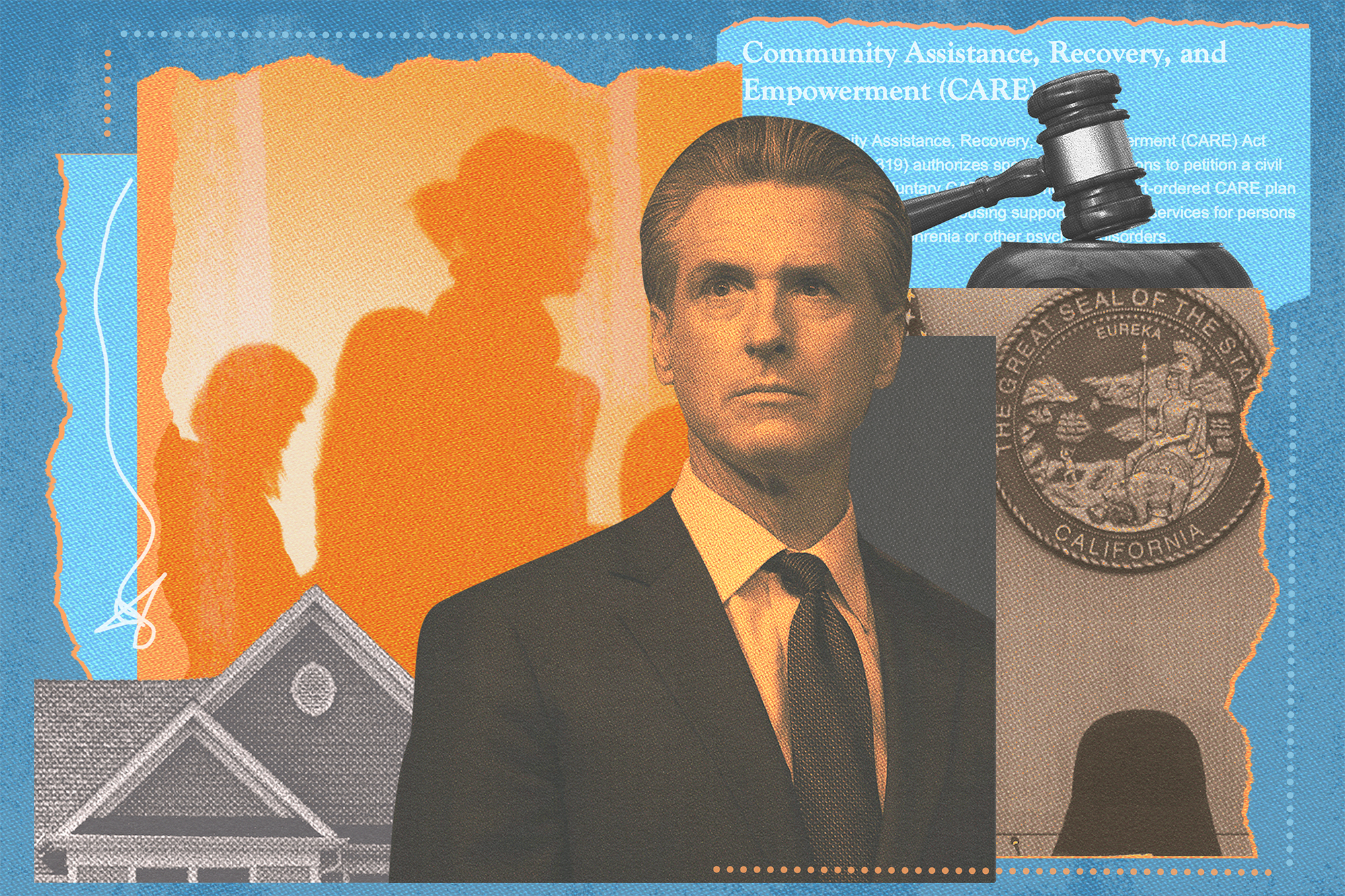
The program was designed to allow family members, first responders, doctors and others to petition the courts on behalf of someone with severe psychosis who can’t take care of themselves. If the petition is accepted, that person can then agree to voluntary treatment, which can include counseling, medication, housing and more.
If they refuse, a judge can order them to participate in a treatment plan.
CalMatters received responses from all but four of the state’s 58 counties. Here’s what the data shows:
- While Newsom’s administration estimated between 7,000 and 12,000 Californians would qualify for CARE Court, just 2,421 petitions have been filed through July, according to the Judicial Council of California. Only 528 of those have resulted in treatment agreements or plans.
- San Diego County anticipated receiving 1,000 petitions in the first year and establishing court-ordered treatment plans for 250 people. But in nearly two years, the county instead has received just 384 petitions and established 134 voluntary agreements.
- Los Angeles County saw 511 petitions filed – the most in the state. Of those, 112 resulted in care agreements or plans. In 2023, officials predicted to news organizations the county could enroll 4,500 people in the first year.
- Courts across California are dismissing a significant percentage of CARE Court petitions – about 45% statewide, although that number includes the handful of cases in which someone has successfully “graduated” from the program. The rate is even higher in some counties, such as San Francisco, where nearly two-thirds of petitions are thrown out.
- The allure of CARE Court for many supporters was the promise of court-ordered treatment plans that would encourage sick people to accept the help they’d been resisting. But the courts have ordered just 14 treatment plans so far, according to the Judicial Council. Instead, most counties are solely offering voluntary treatment “agreements,” which sick people are free to ignore.
- Very few people have successfully completed CARE Court. Despite the fact that it has the most petitions, Los Angeles County has had no graduations. Nine counties have been operating CARE Court long enough to have graduations (the program takes at least a year to complete).
“It’s going much more slowly than we thought it would,” said Lisa U’Ren, a former member of the board of directors at the Solano County branch of the National Alliance on Mental Illness, who helped roll out the program in her county.
The stakes are high for Newsom, who has tied his legacy in part to big promises that he would address California’s twin problems of homelessness and inadequate mental health services. The establishment of CARE Court was followed by a 2023 law intended to make it easier for a judge to order someone into involuntary treatment. A successful 2024 ballot measure issued $6.4 billion in debt to pay for new mental health housing.
Once someone files a CARE Court petition on behalf of a person experiencing psychosis, the county investigates that person’s diagnosis and then the court determines if they are eligible for the program. If they are, they have regular meetings with a case worker, as well as regular court hearings, with the goal of agreeing to a treatment protocol called a “CARE agreement.”
If a voluntary agreement can’t be reached, the court can order the person to follow a CARE plan. After one year, the client can either complete the program and graduate, or extend for up to one more year.
State officials say CARE Court needs more time to hit the goals initially set by the Newsom administration. Already some counties are doing an “incredible job,” said Stephanie Welch, deputy secretary of behavioral health for the state Health and Human Services Agency. She pointed to Alameda County, which has racked up 125 petitions — among the most in the state – since December.
“I think this has been a complicated program to implement,” Welch said, “and that’s something that we recognize and we’ve been doing our best to support the counties to be able to expand this program.”
A spokesperson for Newsom’s office said the administration is pleased with what the program has accomplished so far.
“Thanks to the CARE Act, thousands of people are engaging in critical behavioral health treatment through stabilizing medications, community-based care, and — if needed — housing,” Elana Ross said in an emailed statement.

But disability rights organizations say the low numbers are evidence that the program was a waste of money, a reactionary political gambit by a governor with presidential aspirations. And many families who initially threw their support behind CARE Court also say it has come up short.
Anita Fisher advocated for the program when Newsom proposed it, speaking on 60 Minutes about her family’s story and meeting with the governor himself, she said. When the program was piloted in San Diego County, where she lives, she felt hopeful about its promise to treat people with serious mental illness, like her son.
“I've watched my son suffer too many times: jail, prison, homeless,” she said. “And I said, ‘so if this can stop that?’ I said, ‘Yes, I'm all for it.’”
But now?
“I look at it as a total failure.”
A petition could be rejected because the person doesn’t meet the narrow eligibility criteria (only people with schizophrenia and other limited psychotic disorders qualify). When the subject of a petition is homeless, outreach workers sometimes have trouble finding them on the street. Other times, the client simply refuses services – and, CARE Court has little teeth to force them to accept, even after a judge’s order.
Making more people eligible for CARE Court
A bill making its way through the Legislature could boost CARE Court numbers by making more people eligible. If Sen. Thomas Umberg’s Senate Bill 27 becomes law, people who experience psychotic symptoms as a result of bipolar disorder would qualify for the program.
The program as it stands is not broken, the senator said, it’s a “work in progress” that needs some tweaking to reach its full potential.
“To some degree, expectations were raised, some that were accurate, some that were not accurate, that this was going to be a panacea,” Umberg said. “And I never thought of it that way.”
But it’s unclear how many more people could enter into CARE Court as a result of Umberg’s bill. His office has no estimate, and other guesses vary widely. San Diego County says the bill could increase its numbers by anywhere from 3.5% to 48.1%.
Many disability rights organizations strongly oppose the bill, saying it will significantly expand an ineffective program, doing nothing to solve underlying issues of housing shortages and inadequate mental health services
“They’re not trying to fix a problem, they’re trying to deliver political optics, and that’s all this ever was,” said Lex Steppling, a founding member of All People’s Health Collective.
Eve Garrow, a senior policy analyst with the American Civil Liberties Union of Southern California, said that, “given what I consider to be the failure of CARE Court so far,” she expects Umberg’s bill is primarily an effort to increase the number of petitions.
“A court order doesn’t make resources appear out of thin air,” she said.

The state spent $88.3 million on CARE Court in the 2022-23 fiscal year, and $71.3 million in 2023-24, according to a Legislative Analyst’s Office analysis. With fewer than 550 people receiving services through the program so far, critics accuse CARE Court of wasting state money.
The Assembly Judiciary Committee’s July analysis of SB 27 described CARE Court as a “very expensive” way to coordinate services.
But California counties say the low numbers of CARE agreements don’t capture the entirety of the program’s impact. Even petitions that don’t lead to official agreements have afforded counties the chance to connect with and offer services to people they hadn’t previously known.
“I would say that I think the whole idea of looking at the numbers, it sort of misses the point,” said Michelle Doty Cabrera, executive director of the California Behavioral Health Directors Association. “With anything coercive, the goal is to try to engage people out of their own free will into services.”
One of CARE Court’s successes, she said, has been in spreading the word about county services to people who might need them. If those people then express interest without the need for any coercion, “that’s a success and so far that has not been quantified,” she said.
The state has attempted to quantify that elusive number: As of December, people were diverted away from CARE Court and into other county services 1,358 times, according to a recent report from the Health and Human Services Agency.
Counties administering CARE Court also said it’s one of the few state programs that funds outreach. It can require a lot of attempts before outreach workers can coax certain people into services, they said, and this provides a mechanism to pay for those efforts.
A flood of petitions that never materialized
Eight California counties rolled out CARE Court at the end of 2023, as part of a pilot group. The rest of the state had the program up and running by December 2024.
As San Diego County counted down to the launch, officials worried they would be flooded with petitions immediately, said Amber Irvine, the county’s behavioral health program coordinator.
The county hired nearly two-dozen people, including 10 clinicians, two psychologists and support staff to meet the expected demand. The money for those new positions came from county funds, not from the state.
That flood of petitions never materialized.
Irvine thinks the process of filing a petition was harder than expected. Her team thought first responders, hospitals and behavioral health workers would jump at the chance to refer people into the program. But that didn’t happen. The petitioner has to attend at least the first court hearing, which is something many overworked first responders and clinicians can’t do, Irvine said.
Police and firefighters filed petitions when the program first started, but they were often dismissed – which made the first responders reluctant to file more, said Crystal Robbins, who manages a treatment referral program for San Diego Fire-Rescue.
“We quickly found out that it wasn’t a useful tool for the people that we see,” she said.
The process also is tough for families petitioning on behalf of loved ones, Irvine said. It requires them to prove their loved one has a qualifying mental health condition, but federal privacy laws can make that a big hurdle.
The county is trying to make the process less cumbersome, Irvine said. It is letting family members and some other petitioners attend court hearings virtually, for example. And in some cases, the court is allowing petitions to move on to the next step even if they don’t have all the required paperwork.
So far, San Diego County Superior Court has received the second-largest number of petitions in the state — 384, with 35% leading to CARE agreements.
But that’s still far behind initial projections.
The slow start could be a “happy accident,” Irvine said, because the low case load allows clinicians to spend more time with each CARE Court client.
But Anita Fisher isn’t the only family member who feels discouraged about the program’s roll out in San Diego.
Tanya Fedak said she has twice filed petitions in the county on behalf of her son, who continues to cycle between homelessness and jail despite being accepted into CARE Court.
“These are our loved ones,” she said. “It's our taxpayers’ money. There's no accountability. And it's frustrating to see it go down, because my son is going to end up dead.”
Orange County, which was part of the initial CARE Court cohort, expected to receive 1,400 petitions and establish between 400 and 600 treatment plans its first year. Two years later, it has received at least 176 petitions , reached 14 CARE agreements and ordered one CARE plan, according to the county’s behavioral health department. That doesn’t include additional petitions that could have been dismissed by the court before reaching the county.
Orange County was the only superior court in the state with a significant number of petitions that did not disclose its data to CalMatters.
Veronica Kelley, director of the Orange County Health Care Agency, said she never expected to reach as many people as the original estimate. She attributed that in part to the county already reaching many people with schizophrenia spectrum disorder through its existing assisted outpatient treatment program (the program created by the law Newsom criticized at the 2023 press conference), which provides similar services to CARE Court.
Kelley believes expanding the older program would have been a better use of the resources now going to CARE Court. In part, she said, that’s because Orange County’s assisted outpatient program makes it easy for people to ask the county for help, whereas filing a CARE petition is “a laborious process” that requires significant work from the petitioner.
Other people blame the low CARE Court numbers on a lack of awareness.
After CARE Court rolled out in Solano County, the local branch of the National Alliance on Mental Illness hosted town halls to teach the community about the program. An in-person town hall drew about 10 people, said NAMI Solano County Executive Director Deb Demello. Two Zoom meetings drew about four people each. And they didn’t see people from the main group they were trying to reach: family members of people with a severe mental illness.
“We had very little turn out,” Demello said.

CARE Court use varies widely county by county, with some smaller counties appearing to struggle with the resources to implement the program. Colusa County, with a population of fewer than 22,000 people on the edge of the Mendocino National Forest, told the state last year that its courts weren’t prioritizing CARE Court because of court vacancies. The county has received just one petition.
Eight small counties, including Mendocino and San Benito, said they’ve had no petitions filed.
Some county courts refused to disclose their data to CalMatters because the numbers were too small, citing the California Rules of Court, which allow courts to withhold data if the sample size is so small that people could be identified.
Courts are required to report limited CARE Court data to the California Judicial Council, including the number of petitions submitted, number of agreements and plans, and number of dismissals. But the council would give only statewide totals to CalMatters, not a county-by-county breakdown.
Will expanding CARE Court help more people?
Even if someone becomes one of the few Californians represented in a CARE Court petition, it doesn’t mean they’ll get help.
In San Francisco, the majority of petitions filed end up getting dismissed – 49 of the 75 – or 65% – of those filed. That’s one of the highest dismissal rates in the state.
Some counties, including San Francisco, told CalMatters that people may still receive services even if their CARE Court petition is dismissed. But a state report released in July found that of the 160 people whose petitions were dismissed during the first nine months of CARE Court, 90 did not receive county behavioral health services.
Of the 130 petitions dismissed in Los Angeles County between December 2023 and February of this year, 43 were dismissed because the person was already receiving “adequate mental health services,” according to a report by the county’s department of mental health. It’s the most common reason for a dismissal in that county.

Umberg wants to address that with his bill. Currently, someone can’t qualify for CARE Court if they are already “clinically stabilized” in another treatment program. Umberg’s bill would clarify that just being enrolled in an outside treatment program doesn’t mean someone is stable. He hopes that will cut down on the number of people whose petitions are dismissed even though their mental illness is not under control.
His bill would also make it easier for the criminal justice system to funnel people into CARE Court, by allowing a judge to refer someone directly into the program if they are charged with a misdemeanor and deemed incompetent to stand trial.
Irvine, San Diego County’s behavioral health program coordinator, is not thrilled about Umberg’s plan to expand CARE Court. The California Behavioral Health Directors Association also opposes the bill.
Irvine takes pride in the amount of time and energy her staff put into each CARE Court client. She says they spend weeks or even months getting to know them, bringing them their favorite foods, and helping with minor tasks, such as getting a new phone, before finally convincing them to participate in the program. In at least one case, that process took as long as five months, she said.
By some accounts, San Diego County’s approach is working. It has had 10 graduations so far, the most of any county that reported that metric to CalMatters.
Adding a lot more people into the program would give clinicians less time to spend with each client, Irvine said. And Umberg’s bill doesn’t come with money to hire more staff.
About the data
The county data in this story is based on public record requests to California county courts and behavioral health departments about CARE Court usage. See full methodology and download the data.
This article was originally published on CalMatters and was republished under the Creative Commons Attribution-NonCommercial-NoDerivatives license.
link