Effect of age and disease on saliva and serum biomarkers of stress, inflammation, immunity, redox and general health status in pigs
The results obtained in the age, sex and sample type interactions appear in Table 1. Since no significance was found when evaluating the potential interaction between sex of the animals and either sample type or animal age in healthy animals, the variable sex was excluded from the statistical analyses. Therefore, all the data presented includes all animals used in the study, integrating males and females as a group.
Differences in various analytes were found when evaluating the interaction between sample type and animal age, as well as between sample type and health status. Detailed pairwise comparisons evaluating those interactions are provided in Tables 2, 3, 4 and 5.
The effect of age and sample type in healthy animals
When changes in analytes were evaluated during different times of a fattening cycle, differences between the dynamics in saliva versus serum were seen in all analytes, with the exception of FRA, Urea, Triglycerides and Ca that showed a similar evolution in saliva and serum during the different timepoints. Although Sample type*Age interaction was significant for AA and P, a similar behavior was seen in saliva and serum after pairwise Bonferroni correction. Similarly, the interaction was not significant in the case of Hp; however, a different dynamic was seen between saliva and serum after Bonferroni correction.
In saliva, most of the analytes showed higher values at T0 with the exception of UA, which had higher values at T1 compared to T0 and T2, and AA, CRP, Ferritin, FRA, and P that did not show statistically significant differences across time points.
In serum, the highest values at T0 were seen in ADA, AOPP, FRA, LDH, ALP, gGT, Ca, Triglycerides and Urea. On the other hand, the analytes that achieved higher values at T1 were CRP, Ferritin, AST and CK. At T2, higher values were observed in IgG and TP compared to T0 and T1. No significant differences were seen in AA, BChE, Hp, MPO and P serum levels along the different time points. UA provided values in serum under the LLOD of the assay.
Effect of sample type in the values of analytes in healthy and diseased animals.
When biomarker levels were compared between healthy and diseased animals, different dynamics were seen between saliva and serum in several analytes, with the exception of TP, Ferritin, CK, gGT, Urea and P. TP, Ferritin, Urea and P showed a similar change, with higher values in diseased animals, in both sample types. Conversely CK and gGT did not show differences between healthy and diseased pigs neither in serum nor saliva. Although MPO and AST did not show a significant Sample type*Health condition interaction, a different dynamic was seen in those analytes after Bonferroni correction.
Both serum and saliva samples showed higher values in diseased animals than in healthy ones for IgG, CRP and Hp, however, the magnitude of these differences varied between the sample types. IgG and CRP showed a higher response in saliva (6.8 and 5.9-fold, respectively) than in serum (2.1 and 4.0-fold, respectively); whereas in Hp the response was slightly higher in saliva (4.4-fold) than in serum (3.8-fold). On the other hand, different behaviour was seen between saliva and serum in AOPP, FRA and Triglycerides, since concentration of these analytes were higher in saliva of the diseased animals compared to healthy ones (3.5, 2.6 and 1.5-fold, respectively), whereas in serum their concentrations were lower in diseased animals than in healthy (0.5, 0.7 and 0.7-fold, respectively).
In the cases of AA, ADA, MPO, AST, LDH and Ca, changes were seen only in saliva, with values significantly higher in diseased animals (3.3, 3.1, 2.2, 2.8, 7.1 and 1.4-fold, respectively) than in healthy ones. Whereas levels of BChE and ALP in the serum of diseased animals were respectively 0.5- and 0.4-fold, lower than those observed in healthy ones, with no differences found in saliva between both groups of animals.
The levels of UA in serum were all under the LLOD of the assay, so only salivary levels were studied. Salivary UA did not show differences between both groups.
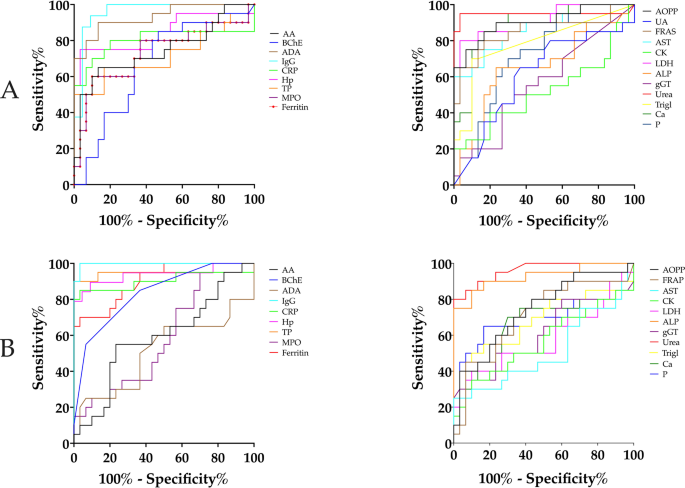
The results of the ROC analyses in saliva and serum are shown in Table 6; Fig. 1. The results showed that 17/21 analytes in saliva, and 13/21 in serum, had the ability to discriminate between healthy and diseased animals. In saliva, both stress biomarkers (AA and BChE) significantly discriminated between groups, but whereas AA was not useful in serum, BChE in serum showed a better performance than in saliva. The best performance in saliva was seen for the immune system biomarkers ADA and IgG, both showing AUC > 0.9; in serum, IgG also showed AUC > 0.9 but ADA was not significant. In inflammatory biomarkers, all analytes showed AUC with significant power to discriminate between healthy and diseased pigs, with AUC values in both saliva and serum higher than 0.7, with the exception of MPO in serum, which showed non-significant values. The redox status biomarkers AOPP and FRA had significant AUC in both saliva and serum. In contrast, salivary UA was not able to discriminate diseased from healthy animals. Regarding tissue damage biomarkers, AST and LDH in saliva showed a significant AUC, with values higher than 0.7. The analytes Urea, Triglycerides, Ca and P showed a significant AUC in both saliva and serum, being Urea the best one with AUC > 0.9 in both sample types. Serum ALP also showed a significant discriminatory power with AUC > 0.9, but it was not significant in saliva.

Receiver operating characteristic (ROC) curves obtained with the different analytes in saliva (A) and serum (B) for discriminating diseased animals (A. pp infected, n = 20) from healthy animals (T1, n = 30).
Spearman correlation between serum and saliva
Table 7 shows the Spearman correlation coefficients obtained between saliva and serum values. The correlation saliva – serum was mild for IgG and Urea, and weak for ADA, CRP, Hp and Ca. No significant or negligible correlations were obtained for the rest of the analytes.
link